
Dodecanese yacht charter: Rhodes, Symi, Kos and Patmos
November 27, 2026
Although not that far from Turkey (so near that you could wave across), the Dodecanese islands are very different from the rest of Greece. As well as castles, Italian harbour areas can still be seen and there are hill-top monasteries. Even more strangely, there is a volcano which you can walk into. Small islands are also dotted around and the ferry service runs to them a couple of times a week. Overall, the Dodecanese offer great diversity, good anchoring and a sailing season that extends into autumn. Here we explain more about the islands, outline two 7-day itineraries that we favour, and highlight some key information to consider when arranging your yacht charter.
What makes the Dodecanese worth the trip
As the name suggests, there are more than 12 islands. Throughout history, Rhodes was ruled by the Knights of St John for 200 years. Then followed the Ottoman and Italian periods, and it was only after the Second World War that the islands became part of Greece. As you sail around, you can witness these different time periods. Sometimes you may dine within medieval fortifications, then the following day amble along an Italian promenade. The day after that you could easily be moored on a quay with just one taverna!
In terms of organisation, this is a straightforward region. The islands are arranged in a line, with Rhodes at the southernmost and Patmos at the northernmost, so the distances between them are generally short. And regardless of the prevailing wind direction, there are always good anchorages and bays available. Both Rhodes and Kos also have international airports so flight arrangements are uncomplicated.
Compared to the Cyclades, the Dodecanese are much less busy, although this is often under-recognised. Apart from Rhodes Town and Kos Town which can be busy in the height of summer, for the most part even in August these islands are not at all over-populated.
The islands, one by one
Rhodes
Not only is Rhodes the largest of the islands, but it is also a common starting point for charters. The Medieval City of Rhodes is a UNESCO World Heritage Site and is in excellent condition. Highlights include the Palace of the Grand Master and the Street of the Knights. Continuing along the eastern coastline leads to Lindos, where an acropolis towers above the village. Underneath are two lovely bays. Ideally, spend at least one night here, either before or after your charter.
Symi
Again and again our charterers cite Symi as their favourite island. Best approached by boat, the pastel-coloured neo-classical buildings are built up a hillside and surround the harbour. Towards the southern end of the island is the Panormitis Monastery, which boasts its very own tranquil bay. Symi is quite small, so a day plus one night is normally sufficient. However, we have never known anybody to complain about staying longer.
Tilos and Nisyros
Situated between Rhodes and Kos, Tilos is a laid-back island and is not especially busy. Nisyros is a volcanic island. You can ascend to the crater of Stefanos and then descend onto the actual crater floor. The earth emits steam and the atmosphere has a sulphurous odour; we would rank this as one of the most unique experiences possible in the Aegean.
Kos
Green and vibrant, Kos is also highly accessible. Within Kos Town, Hellenistic and Roman artefacts can be found dotted around modern buildings. Immediately outside the town is the Asklepieion, an ancient healing sanctuary associated with Hippocrates who was born on Kos. Many charters also set off from here heading north.
Pserimos and Kalymnos
Tiny Pserimos, nestled between Kos and Kalymnos, consists largely of a lengthy sandy beach. This is exactly what appeals about it. Kalymnos is well known for its sponge diving industry and, more recently, for rock-climbing on its limestone faces. On the western coastline there are excellent bays for anchoring.
Leros, Lipsi and the small islands
Leros has a huge natural harbour at Lakki. There is also a town here which was built by the Italians in a distinctive 1930s style. To the north is Lipsi, a small and welcoming island. Again there is clear water and an attractive harbour village. Just across from here are the tiny islands of Arki and Marathi which share a couple of tavernas and also boast some of the most peaceful mooring spots in the area.
Patmos
It is traditionally believed that St John wrote the Book of Revelation on Patmos. The Monastery of St John and the Cave of the Apocalypse, together with the old Chora, are on UNESCO’s list. The island exudes a peaceful and graceful ambience and is a good choice to round off a week’s cruising. Unfortunately there is no airport so, should you wish to finish here, you will either catch a ferry or be returned to Kos or Leros by yacht.
Astypalaia
Astypalaia lies to the west, half-way between the Dodecanese and Cyclades. Its Chora (on a hill, complete with castle and windmills) is, in our opinion, one of the most beautiful in Greece. Due to its slightly more secluded location, we usually suggest this island for extended charters or as part of a charter which combines both the Dodecanese and Cyclades.
Two 7-day Dodecanese routes
As ever, the following are just examples. Your captain will adapt the schedule to suit prevailing winds and your preferences.
Rhodes to Kos: the southern islands
You begin in Rhodes. Spend the first evening exploring the medieval town and then enjoy your evening meal either on or off board. Day 2 sees you heading south along the eastern coastline, to Lindos where you can visit the acropolis and swim in the bay. Day 3 involves the passage to Symi and ideally you should arrive in Gialos in the late afternoon to make the most of the quality of the light. Day 4 is spent visiting Panormitis and then relaxing in the peaceful southern bays.
Tilos is day 5. This is generally a relaxed day and your anchorage is likely to be fairly exclusive. Day 6 takes in Nisyros and its volcano. Finally, on day 7 you continue on to Kos for a last swim and then spend the evening in Kos Town. You go ashore here and fly home.
From Kos: the northern loop to Patmos
Start in Kos and then cross briefly to Pserimos. Day 2 is spent on Kalymnos with an anchorage off the west coast. Day 3 sees you on Leros, either at Lakki or in more northerly bays. Day 4 is Lipsi and its harbour and beaches. Usually, day 5 (Arki and Marathi) is the quietest day of the week. On day 6, Patmos is visited. Visit the monastery early to avoid the heat and then dine in Skala or within the Chora. Day 7 is the return journey southwards to Kos, with a swimming stop-off en route.
Should you have 10 days or more, these itineraries can be combined. Alternatively, you could include Astypalaia and connect the Dodecanese with the eastern Cyclades.
Who we’d recommend it to
Primarily for history buffs. It is difficult to envisage a part of Greece which offers such a varied historical experience. From the knights of Rhodes, to Kos’ ancient medical history and Patmos’ monastery, alongside Leros’ Italian town design. It is also excellent for those who have already experienced the Cyclades and are seeking something more tranquil. Plus, it is well suited to families as many of the legs are short and the harbour villages are both child-friendly and easy to navigate.
However, if you are keen on a lively evening each night, then this isn’t quite as suitable. Although Rhodes and Kos offer a wide range of evening activities, for the most part the smaller islands become subdued after dinner. Yet, for many of our clients, this is precisely the appeal.
Some practical advice from us
Fly in to Rhodes and fly out from Kos (or vice versa) to avoid a long last leg. Both Patmos and Lindos become very hot and are popular for daytime tourists so it is a good idea to visit them in the morning. Ensure you have suitable footwear for exploring Nisyros as the crater is irregular and the surface can be quite hot. If there are places of religious interest you would like to visit, please inform the crew so that they can establish what times of day they are open and what is expected in terms of clothing.
Weather, and when to go
The season normally runs from May until the end of October, and the Dodecanese are known for staying warm late in the year. This means that September and October are particularly good. Although the Aegean’s northerly summer wind, the meltemi, also affects these islands in July and August, the advantage of the archipelago is that the captain can almost always locate a sheltered bay or harbour to overnight. To benefit from good temperatures, reduced winds and less crowds we would suggest travelling in June or September.
Popping over to Turkey
From a number of these islands it is possible to view Turkey and occasionally guests wish to also spend a day on the Turkish side. On occasion this is possible. However, there is no quick process for leaving Greece and arriving in Turkey; there are official procedures for the yacht and crew, plus guests, to leave Greece and then enter Turkey. Whether or not this is feasible will depend on the yacht’s documentation and the charter agreement. Please let us know at the outset if this is something you are interested in and we will investigate this with the yacht prior to booking.
Which yacht suits the Dodecanese
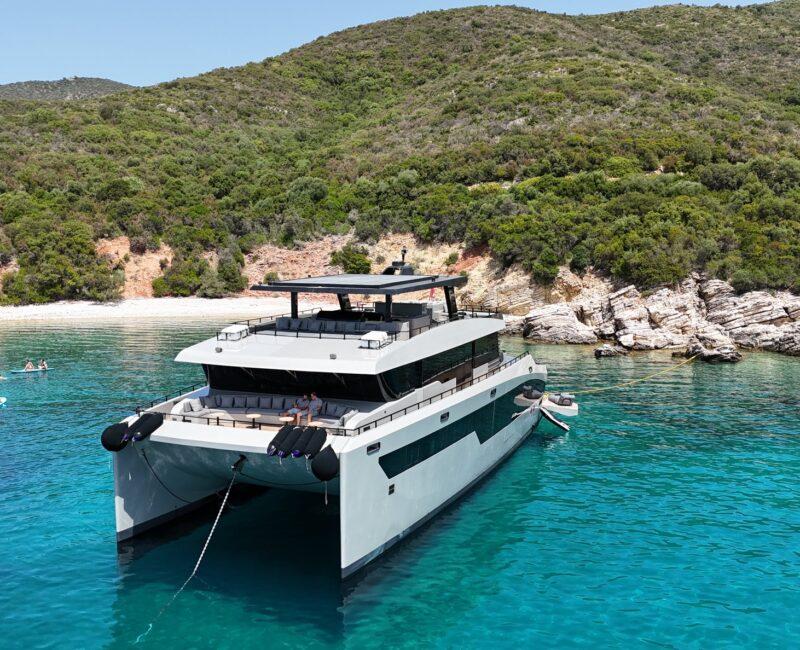
Generally we would recommend a motor yacht with a crew as this offers the greatest scope for exploration. Even the longer passages such as Rhodes to Symi or Patmos to Kos are easily managed. Sailing yachts and crewed catamarans also perform well, particularly during the shoulder season. They are also good for the shorter passages between Kos, Kalymnos, Leros and Lipsi.
Flights, and where charters start
Rhodes and Kos are the primary base points for charters and have international airports together with marinas. There are also small airports on Leros and Kalymnos and these offer domestic flights. One-way charters between Rhodes and Kos are frequently undertaken and are ideal for a laid-back holiday. However, the yacht may levy a ‘delivery’ charge to return to its base. Our guide to the ports Greek yacht charters start from includes an analysis of the options including Athens as a base.
What a Dodecanese yacht charter costs
Whilst considering location, it is usually the yacht itself which has the biggest impact on cost. Our Greece Yacht Charter Price Index indicates that, for 2027 summer, the median cost per week for a Greece based yacht is €59,000 for low season and €69,000 for high season. Then there are further costs to consider: APA (for fuel, provisions and port expenses), VAT and an optional crew tip. If the yacht of interest is based in Athens, enquire about the cost of ‘delivering’ it to Rhodes or Kos as this distance is considerable.
In respect of taxation, 13% VAT is typically payable on a crewed charter in Greece. However, the majority of quotations will indicate either 5.2% or 6.5% as vessels which hold correct certification are taxed on a reduced share of the fee. Please refer to our article on VAT on a yacht charter in Greece for further information together with references to official material.
Planning a Dodecanese week with us
Since 2017, we have been based in Athens and provide charter, sales and yacht management services globally. Please tell our charter team your preferred dates, party size and type of holiday and we will get back to you. Compare destinations using our main page on yacht charter in Greece together with our Ionian guide and all our Mediterranean charter guides.
Frequently asked questions
Where do Dodecanese yacht charters start?
Usually Rhodes or Kos. Both have international airports and marinas. One-way charters also often take place between these two islands.
When is the best time for a Dodecanese yacht charter?
June and September offer good temperatures, not too strong winds and lower levels of crowds. The season typically spans from May to October. Often, the Dodecanese are still quite warm later in the year.
Is the Dodecanese affected by the meltemi?
Yes. Although the northerly summer wind can affect the area, again thanks to the high number of inshore bays and marinas, it is generally possible for a skipper to plan around it.
Which Dodecanese islands can we see in a week?
If you are chartering from Rhodes to Kos you can easily visit Lindos, Symi, Tilos and Nisyros. Alternatively, if departing from Kos, you could visit Pserimos, Kalymnos, Leros, Lipsi, Arki and Patmos.
Can we visit Turkey during a Dodecanese charter?
This can be done on occasion. There are official processes that must be followed for both the yacht and crew and passengers to leave Greece and enter Turkey. Whether this is possible also relies on the yacht’s documentation and charter agreement. Please contact us if you wish to explore this option.
How much VAT is charged on a yacht charter in the Dodecanese?
For crewed charters in Greece a 13% rate applies. However, yachts which hold correct documentation are invoiced on a reduced amount so VAT is most commonly shown as either 5.2% or 6.5%.
See more Oxyzen Yachting superyacht charter guides in Google:
Recommended Articles
Apostolos KorakasApostolos KorakasApostolos KorakasApostolos KorakasApostolos Korakas